
2026-11-12

Type "piling machine" into a marketplace search and the results will include machines that share a purpose and almost nothing else: a track-mounted rotary unit with a kelly bar, a lattice-boom crane swinging a diesel hammer, an excavator with a vibratory head clamped to the end of its arm. The vocabulary makes it harder rather than easier. Piledriver, piling rig, pile boring machine, drill rig and rotary drill get used as if they were interchangeable, yet a quotation written with one of those words can describe a machine the other four would never cover.
This guide separates the family along two lines that survive translation: what carries the machine, and what it holds at the bottom. Fix those two and the name usually sorts itself out.
A piling machine is identified by its attachment far more than by its chassis. Swap the head and the same carrier becomes a different machine; the same hammer can hang from a crane one week and ride a leader mast the next. Names therefore settle on whichever part of the assembly the speaker works with. A crew that drives piles talks about the piledriver. A dealer selling the complete unit says piling rig. An engineer designing a bored shaft says pile boring machine or rotary drill, because on that side of the family nothing is driven at all.
The practical consequence is blunt: a listing that says only "piling machine" tells a buyer nothing about capability. Three questions do the classifying — what the machine stands on, what it holds, and what ground it is expected to pass through.
Most piling machines begin life as a crane or an excavator, or as a purpose-built track unit that borrowed the same layout. Manufacturers such as Liebherr and Sennebogen have built carriers specifically for foundation work, and in some markets those machines are still called baggers.
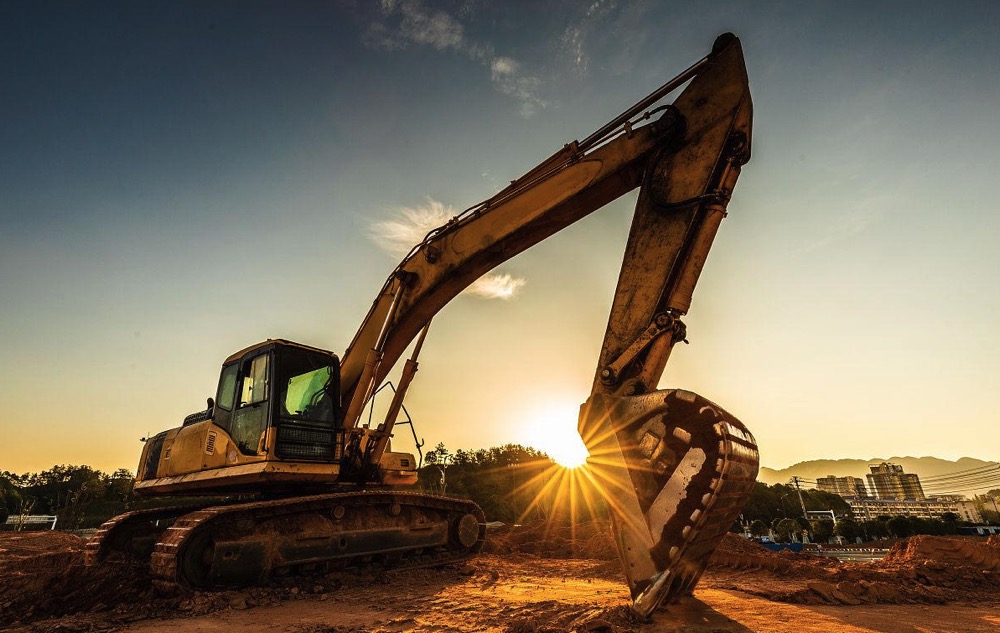
The excavator version keeps a short, horizontally aligned boom and uses it to hold a vertical leader mast. The geometry is compact, the machine walks itself around the site, and the mast stays close to the tracks — useful where the work front keeps moving and where headroom is limited. The same carrier is a natural home for vibratory and press attachments.
On a crane configuration the mast sits at the peak of the lattice boom. Reach and lifting capacity come from the crane; the pile's line comes from the leads and from the operator's control of the load. This arrangement suits long piles and sites where the crane is already there for other lifting work.
The third arrangement looks like a large track-mounted drill: a heavy base, a mast, and a rotary head that travels along it. Nothing is dropped. The machine forms a hole, and the pile is either cast into it or lowered into it.
That list already removes most of the confusion. A piledriver describes an attachment and a driving action; a piling rig describes a carrier plus a leader or mast; a rotary drill describes the boring side.
On the driving side, five attachment families cover most of the work: diesel hammers, vertical travel lead systems, hydraulic hammers, hydraulic press-ins, and vibratory drivers or extractors.
A modern diesel pile hammer works like a large two-stroke diesel engine turned upright. The piston is the striking weight; the cylinder is attached to the top of the pile. Raising the piston draws air into the cylinder, diesel is injected, and the falling piston compresses the mixture until it ignites. The expansion throws the piston back up and sends energy into the pile head. The cycle repeats and each stroke takes the pile deeper. The appeal is self-containment — no separate power pack, no hydraulic umbilical — and the trade-off is noise and exhaust exactly where the work happens.
These systems guide the hammer along the mast and come in two main forms. Box leads are common in the southern United States; spud leads are more typical in the northern states, Canada and Europe. The split reflects regional practice and project requirement, and it changes how the hammer is held and how the pile is kept in line during driving.
Hydraulic hammers were developed as a modern alternative to diesel and air hammers and are used on steel, concrete and timber piles. Overall they generate less noise and less pollution. The qualification matters: the impact itself is still loud, so noise at the moment of strike can come close to a diesel hammer. Buyers who expect a hydraulic hammer to be quiet at the pile head are usually disappointed on site.
Press-in machines use hydraulic rams to push the pile into the ground instead of striking it, which puts them first where vibration has to be kept to a minimum. Press attachments can be fitted to conventional rigs, and sheet piles can be pressed in simultaneously. Other press equipment can be mounted on piles already in the ground, so the reaction force is shared and greater pressing force becomes available. The method is also unusually precise in positioning.
Vibratory units are driven by hydraulic motors and use counter-rotating eccentric weights to send vertical vibration into the pile. They work well where noise is restricted and where vertical clearance is tight, and they can hang from a crane or be mounted on an excavator. Vibration rate is adjustable, which is what lets one unit handle different soil conditions and project requirements. Their second advantage is reversibility: the tool that drives a pile can also pull it.
The boring half of the family exists because some ground, and some designs, will not take a driven pile. Rigs on this side resemble large track-mounted drills, which is why piling rig, pile boring machine, drill rig and rotary drill overlap so heavily in everyday speech. They work through sand, clay and rock, and they are matched to the stratum by their tooling:
The lesson in that short list is that the tool string, not the carrier, decides whether a rig can handle a given site. A machine that performs well in clay can be out of its depth in rock if the head and the tool are wrong — and no amount of carrier size compensates.
Two further checks belong in every enquiry. First, what the machine must do after installation — cut-off level, pile cap construction, and how the next operation reaches the pile head. Second, whether the attachment and tooling come with the unit, because on the boring side they frequently do not.
A name says nothing about energy per blow, torque, extraction force, mast height, or the pile section a machine can handle. Those figures live in the datasheet and in the geotechnical report, and they are the ones that decide whether a machine fits. Using the vocabulary well means knowing which branch you need; it does not replace the specification. The reliable habit is to ask any seller three things: which carrier, which attachment, and which tool set ships with it.
MechLink is an industry expert in used construction equipment and a trusted machinery trader. The stock covers cranes, road equipment, quarry, earthmoving, piling machinery, drilling and underground mining, and every quotation is issued with the information and photographs of that specific unit before a sale is agreed. Inspection, documentation and shipping run through the same process, so the buyer stays informed from the first enquiry to delivery. Send your requirements through the MechLink contact page and the team will match the machine to the work rather than to the label.

Heat, Rock and Uptime: Specifying a Caterpillar Excavator for Middle East Work
2026-11-12

Loader Classes Explained: Matching Machine Type to Material, Space and Cycle
2026-11-12

What an Excavator Is Worth After Five Years - and How to Protect It
2026-11-11
How to Buy an Excavator: A Practical Guide
2026-11-11