2026-09-04
If you searched “how many spark plugs are in a diesel”, you probably own (or maintain) a tractor, excavator, dozer, or loader, and you’re trying to fix a hard-start issue or plan routine service. But the answer is zero. The part you usually need to think about is actually the glow plug. This guide explains the difference in plain English and shows what to check next.
Diesels do not need sparks to run. A diesel engine lights fuel using heat from compression, not an electrical spark.
Clear statement: “Gas engines need a spark to start the fire, but diesel engines make heat, so the fuel lights by itself.”
This design matters for troubleshooting. If you treat a diesel like a gasoline engine, you will often buy the wrong part and miss the real problem.
A spark plug makes a spark to ignite a fuel-air mix. A gasoline engine pulls in air mixed with gasoline, compresses it, and then the spark plug fires at the right time.
This spark happens again and again. A gas engine needs spark plugs working correctly on every cycle to run smoothly.
That is why spark plugs are a normal service item on gas equipment. Many off-road fleets include gasoline machines like small generators, pumps, and some UTVs, so the “spark plug habit” is easy to carry over by mistake.
A diesel ignites fuel with hot, compressed air. A diesel cylinder pulls in air only, then compresses it very hard, which raises the air temperature dramatically.
Fuel is injected at the end of the compression stroke. The injector sprays a fine mist of diesel into the hot air, and the fuel auto-ignites without a spark.
Quote you can remember: “In a diesel, compression is the match.”
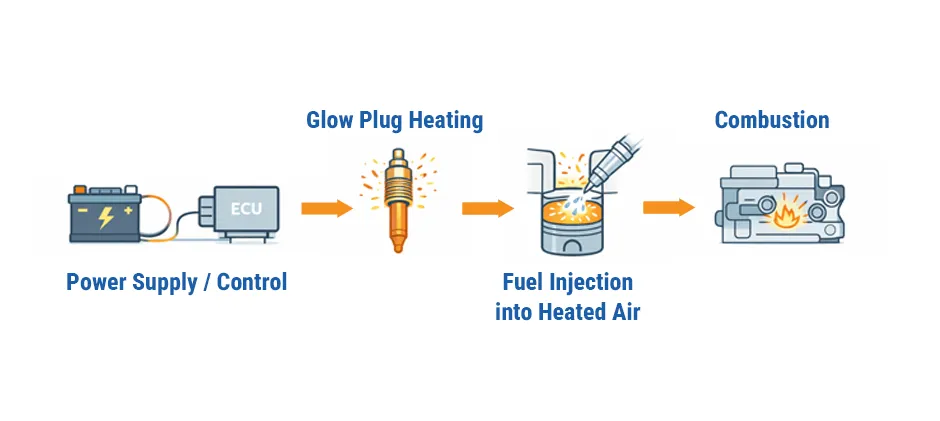
Glow plugs are the “starting helper” on many diesels. A glow plug is a small heater that warms the combustion area so the first combustion can happen during a cold start.
Glow plugs are not used like spark plugs. Spark plugs fire constantly while the engine runs, but glow plugs mainly work before and during startup (and sometimes briefly after).
This is why the search happens. Many owners search “how many spark plugs are in a diesel” when the real problem is cold-start heat, not ignition spark.
Most diesels use one glow plug per cylinder. This makes the math simple when you order parts.
Clear statement: “If your diesel has four cylinders, plan on four glow plugs.”
One exception is worth knowing. Some diesels use an intake air heater (grid heater) instead of glow plugs, and some use both, depending on model and emissions system.
Glow plugs matter most when the engine is cold. Cold metal pulls heat away from the air during cranking, so the air may not get hot enough to ignite fuel quickly.
Short trips can make glow plug issues look worse. If a machine is started, moved a little, and shut down often, it may never stay warm long enough to hide weak preheating.
Cold weather makes everything harder. Batteries deliver less power in cold temperatures, and diesel fuel can thicken or gel, so glow plug problems show up faster.
Hard, cold starting is the top symptom. If the machine cranks normally but takes a long time to catch when it’s cold, glow plugs are high on the list.
The engine cranks but won’t start quickly. This is the classic “morning problem” that improves later in the day.
White smoke often means unburned fuel. Fuel that does not burn in a cold cylinder can leave as white smoke until the cylinder warms up.
A cold cylinder can misfire at first. The engine may shake, stumble, or sound uneven until heat builds.
A glow indicator that stays on too long can signal trouble. Some machines also log fault codes for glow plug circuits, relays, or modules.
Warm restarts can hide the problem. If it starts fine after working but struggles after sitting overnight, glow plugs (or preheat control) are a strong suspect.
Quote to keep it simple: “If it’s only a problem when it’s cold, think heat—glow plugs, batteries, and fuel.”
Most people are trying to do the right maintenance. Spark plug service is normal on gas engines, so it’s a reasonable guess when you’re new to diesels.
Most people are also chasing a starting issue. A long crank feels like “no spark” if your experience is with gasoline equipment.
Clear statement: “The search phrase is wrong, but the goal is right: reliable starting.”
You can often confirm glow plugs by a quick visual check. Look for small pencil-like heaters threaded into the cylinder head with a wire or bus bar feeding them.
You can also confirm by the dashboard light. Many machines show a coil-shaped preheat symbol that turns on before starting.
You should still check your service manual. Some engines use an intake heater, and some have glow plugs that are hidden under covers and piping.
Basic testing beats swapping parts. You can find bad glow plugs with simple tools and careful steps.
A multimeter is the main tool. You can check resistance, voltage supply, and continuity without removing every part immediately.
A clamp meter helps with larger machines. Some glow plugs draw high current, and a clamp meter can confirm current draw on the feed.
Safety comes first. Disconnect batteries before removing bus bars, and keep fuel and solvents away from electrical sparks.
Bad glow plugs often show an open circuit or very high resistance. With the key off and the glow plug disconnected, measure resistance from the glow plug terminal to engine ground.
The exact number depends on the design. Many glow plugs read low resistance, so compare all cylinders and look for one that is clearly different.
Clear statement: “Don’t chase the perfect number—chase the odd one out.”
A good glow plug won’t help if it never gets power. Turn the key to ON and check for voltage at the glow plug feed during the preheat period.
Relays and timers fail, too. If none of the glow plugs get power, the issue may be the relay, fuse, wiring, ignition switch signal, or the controller module.
Quote to remember: “No power in equals no heat out.”
Glow plug replacement is simple but must be gentle. The big risk is snapping a plug in the head, which can turn a small job into a big one.
A cool engine reduces burn risk and thread damage. Let the machine cool and disconnect the negative battery cable.
Clean the area before you open anything. Dirt around the plug can fall into the hole if you are not careful.
Access is half the job. Remove engine covers, intake piping, and anything blocking straight tool access to the plugs.
Take pictures before disconnecting wires. Photos prevent mix-ups, especially when bus bars and clips look similar.
Handle connectors gently. Old plastic clips can break, and damaged connectors can create new starting problems.
Keep hardware organized. Losing a small nut in the engine bay is common and frustrating.
Slow, steady torque is safer than force. If a plug feels stuck, stop and use penetrating oil, then try again later.
Warmth can help in some cases. A slightly warm head can release threads, but follow your manual and work safely around hot parts.
Clear warning: “If it won’t move, don’t win the fight—change your approach.”
Hand-thread first to prevent cross-threading. Start the threads by hand and only then use a socket.
Use a torque wrench if possible. Over-tightening can damage the head or the plug.
Avoid extra chemicals unless the manual approves. Some engines require dry installation, while others allow specific anti-seize in small amounts.
A good test is a normal cold start. Turn the key to ON, wait for the preheat cycle, then start and listen for smoother firing.
Watch the smoke and idle quality. White smoke and roughness should be reduced if the glow plug heat was the problem.
Glow plugs are common, but they are not the only cause. Hard starting in diesels usually comes from heat, speed, fuel, or compression.
Diesels need fast cranking to build heat. A battery that seems “okay” can still spin too slowly in cold weather.
Diesels hate air leaks and clogged filters. A partially blocked fuel filter or a small air leak can delay fuel delivery and cause long cranking.
Bad fuel stops good engines. Summer diesel in winter, water contamination, or microbial growth can block filters and reduce flow.
Compression is the core of diesel ignition. Worn rings, valves, or cylinder wear can reduce heat from compression and make starting difficult.
Clear statement: “If you have fuel and speed but still no start, suspect compression or injection timing/control.”
Small habits prevent big downtime. A few routine checks keep off-road machines reliable.
Quote for shop walls: “Most no-starts are maintenance problems hiding as parts failures.”
To recap, diesel engines have zero spark plugs. The hard-starting problem that likely brought you here points toward the glow plugs.
After diagnosing the issue, the next step is getting the right parts from a reliable source like MechLink.
By checking both, you ensure your entire fleet is ready to work when you are.