
2026-09-19
After identifying the rod bearing failure, it’s also important to know how to choose the right size of a rod bearing.This guide from MechLink cuts straight to the point. We will show you exactly how to understand the confusing “undersize” measurements, correctly select the right bearing for your crankshaft, and verify the fit, ensuring you prevent expensive damage and get your machine back to making you money.
Before we can select a bearing, we must first understand its job. What is a rod bearing in an engine? It’s not a ball bearing with rolling elements. Instead, it’s a precision-engineered shell, a type of “plain bearing,” that sits between the connecting rod and the crankshaft journal.
Its primary function is to create a microscopic space, known as oil clearance. High-pressure engine oil is forced into this gap, creating a hydrodynamic wedge—a powerful film of oil. The crankshaft doesn’t actually touch the bearing; it floats on this oil film, allowing it to rotate thousands of times per minute with minimal friction.
This oil clearance is the engine’s lifeblood. It’s incredibly precise, typically measuring between 0.025mm and 0.075mm (0.001″ to 0.003″), about the thickness of a human hair.
The entire purpose of having different bearing sizes is to maintain this exact oil clearance under different engine conditions.
Here is the most critical concept to grasp, and it’s where most mistakes are made.
Let’s clarify the confusing terminology:
“Undersize” refers to the crankshaft journal it fits, NOT the bearing itself.
This is the root cause of many engine rebuild failures. An inexperienced mechanic might see a worn, undersized journal and mistakenly order a thinner bearing, leading to massive oil clearance, zero oil pressure at the rod, and immediate, catastrophic rod bearing failure.
Common undersized grades for off-road machinery include:
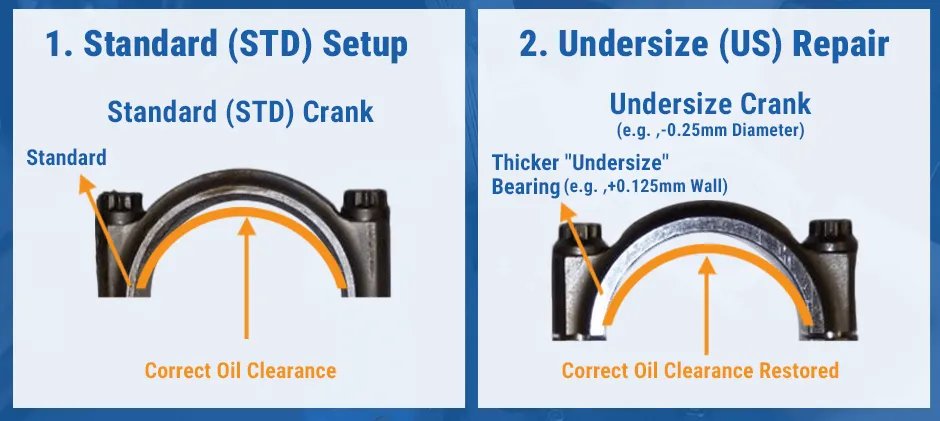
Summary of the “Why”: The only physical difference between bearing sizes is their wall thickness. A thicker (undersized) bearing is used to maintain the life-saving oil clearance when paired with a crankshaft journal that has been machined to a smaller diameter.
Choosing the correct connecting rod bearing is a process of precision measurement, not guesswork. Using the wrong size is a guarantee for failure, turning your rod bearing replacement project into a full engine replacement.
You cannot select a bearing without knowing the exact diameter of the crankshaft journal it will be riding on.
1. Consult the Service Manual: Your machine’s official service manual is your single source of truth. It will list the original standard (STD) diameter for the crankshaft journals, along with acceptable wear limits and the specifications for each undersize grade.
2. Compare and Calculate:
Crucial Pro Tip: If your measurements show the journal is worn beyond the standard limit but not yet at the next undersize level, or if it is out of round, you must send the crankshaft to a professional engine machine shop. They will grind it perfectly to the next clean-up size (e.g., 0.25mm US), and you will then order bearings to match. Do not try to “fix” a worn crank with a new bearing alone.
For Example:
Let’s imagine you are working on an engine, and your service manual provides the following specifications for the connecting rod journals:
Now, you precisely measure your crankshaft journal and get the following readings:
Even after careful measurement and selection, you must perform a final verification. This step is non-negotiable and is what separates professional engine builders from amateurs.
1. Use Plastigage: This is a very thin, deformable plastic thread.
2. Procedure:
3. Measure the Clearance: The Plastigage packaging includes a paper gauge. Compare the width of the crushed strip to the gauge to read the exact oil clearance.
4. Confirm: Ensure this measured clearance falls within the acceptable range specified in your service manual. If it’s too loose or too tight, you must stop and re-diagnose the issue before proceeding.
Understanding this can also help you replace the rod bearing.
The thickness difference between an STD and a 0.25mm US bearing shell is only about 0.125mm—barely visible to the naked eye. That’s why you can’t rely on visual comparison. The diagram below explains the concept:
This table summarizes the relationship between the marking on the bearing, its thickness, and the crankshaft it’s designed for.
| Bearing Marking | Common Name | Bearing Wall Thickness | Fits Crankshaft Journal Size | Application |
| STD | Standard | Baseline Thickness (Thinnest) | Standard (STD) Diameter | New or non-worn crankshafts within OEM specifications. |
| 0.25mm / .010″ | First Undersize | Thicker than STD by ~0.125mm | Smaller than STD by 0.25mm | For crankshafts that have been machined down by 0.25mm. |
| 0.50mm / .020″ | Second Undersize | Thicker than STD by ~0.250mm | Smaller than STD by 0.50mm | For crankshafts that have been machined down by 0.50mm. |
| 0.75mm / .030″ | Third Undersize | Thicker than STD by ~0.375mm | Smaller than STD by 0.75mm | For crankshafts that have been machined down by 0.75mm. |
The rod bearing replacement cost can vary, but the parts themselves are relatively inexpensive. However, the cost of getting it wrong is astronomical. A failed rod bearing can destroy the connecting rod, the crankshaft, and even crack the engine block, leading to a complete engine replacement costing tens of thousands of dollars.
The investment in a good micrometer, a service manual, and the time to do the job correctly is minuscule compared to the cost of failure.
At MechLink, we understand that downtime costs a lot. That’s why we supply a comprehensive range of high-quality, precision-engineered engine components, including a full selection of standard and undersize connecting rod bearings. By following this guide and using the right parts, you can ensure your heavy machinery’s engine lasts, keeping you productive and profitable for years to come. Get the right part, the first time.
Ultimate guide to choosing the best engine oil filter for tractor
2026-09-20
How much does a ford f-150 weigh? 2026 complete guide
2026-09-20
Do diesel engines have spark plugs?
2026-09-19

Best snow removal equipment for winter 2026
2026-09-18