2026-08-25
If you use heavy machinery every day, you know how important hydraulics are. We rely on them for all kinds of heavy, precise work — lifting an excavator boom, pushing with a bulldozer blade, or digging with a loader bucket. And at the heart of every hydraulic system, you’ll usually find an axial piston pump. So what is it exactly? How does it work? Let’s break it down in simple terms.
Its main job is pretty straightforward: it takes power from the engine and turns it into hydraulic power. The engine spins the pump, and the pump pushes oil through the system at really high pressure. That high-pressure oil then moves the cylinders and motors that make the booms, buckets, and other parts move. There are three big reasons this pump is so popular:
Construction equipment like excavators and loaders widely use axial piston pumps.
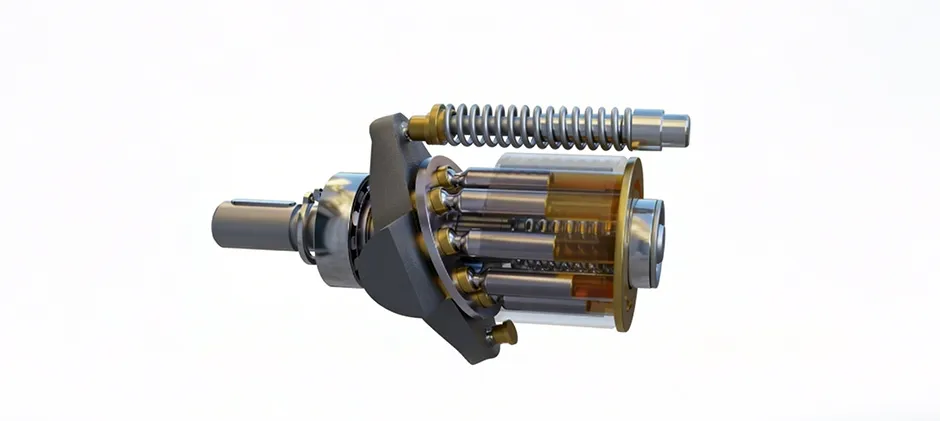
In off-highway machinery, the primary role of the axial piston pump is to provide a steady flow of high pressure hydraulic oil. This pressurized oil transmits power through a hydraulic system and delivers it to various parts of the machine.
For example, the swing motor of an excavator drives the superstructure of the machine to rotate. It is a hydraulic motor that uses oil pressure to generate rotational power. Hydraulic motors work similarly to axial plunger pumps, but in the opposite direction. The pump generates hydraulic power. The motor and cylinder use this power to drive the machine components and do the actual work.
To really understand how an axial piston pump works, first look at a few of the main components inside it. It may seem a bit complicated, but the way they work is actually very simple, just doing repetitive rotation and reciprocating motion together.
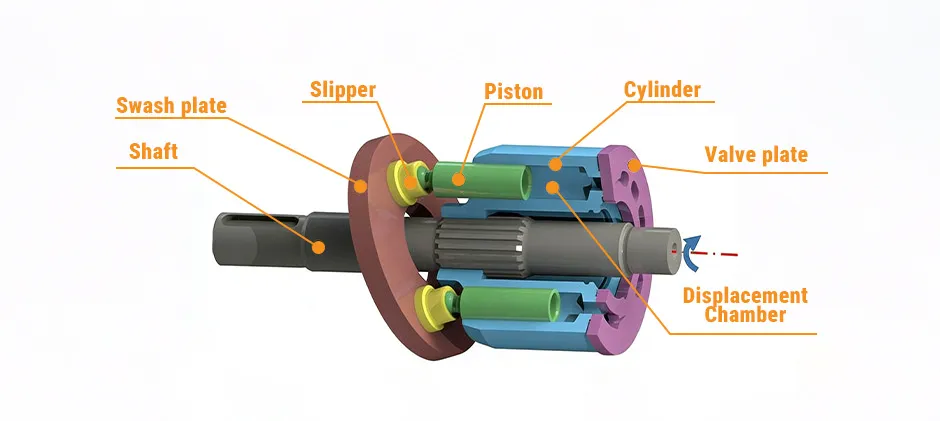
This is the entrance to power. It connects to the engine’s PTO and transmits the engine’s rotational power to the pump. The drive shaft generally has splines for connecting with the cylinder block.
Think of it as the “rotating core” of a pump. Inside, there is a row of holes, each containing a piston. When the drive shaft rotates, the cylinder block also rotates together.
The piston is the main component responsible for pumping work. They slide back and forth in the cylinder bore, sucking in hydraulic fluid and pressing it out. Each piston has a small slide at the end that slides against the swash plate.
The swash plate can be understood as the key component that controls the movement of the piston. It is an angled bevel on which the slipper at the end of the piston slides. The angle of the swash plate determines the distance the piston can travel into and out of the cylinder each time.
Changing the angle of the swash plate controls the flow rate of a variable displacement pump.
This part is responsible for controlling where the oil comes in and out. It is a fixed circular plate with two kidney-shaped channels: an oil inlet (low pressure) and an oil outlet (high pressure). As the cylinder rotates, hydraulic oil is sucked in and out from here in sequence.
The purpose of the bearing is to make the drive shaft and other rotating parts turn more smoothly and reduce friction. The pump operates stably even at high hydraulic pressures.
Now, by looking at these parts together, it is easier to understand how the pump works. In fact, it is a repeating cycle of rotation and piston movement, and it is very fast, happening many times per second.
Imagine, looking at a cross section of a pump. The engine rotates the drive shaft, which in turn rotates with the cylinder block. The pistons rotate with the cylinder block while sliding against the swash plate.
This is how the entire process is continuously cycled: oil absorption → oil pressure → oil discharge. It is this cycle that keeps the hydraulic system providing power.
When the pump is working, all the pistons in the cylinder actually work together. Some pistons draw oil in, and some pistons are pressing the oil out. In this way, while sucking and pushing oil out, the pump can always output stable and continuous high-pressure hydraulic oil.
The great thing about an axial piston pump is that it can turn a simple rotational action into a reciprocating motion of the piston. The most critical component here is the swash plate. The swash plate makes the pistons move in and out, constantly pumping the oil out.
A more important feature is the variable displacement. Simply put, by changing the angle of the swash plate, you can control how much oil the pump outputs.
Adjusting the flow as needed makes the hydraulic system more efficient. The pump delivers exactly the flow the equipment requires, so no power is wasted.
This is the most common cause of many hydraulic failures. If dust, moisture or metal debris gets mixed into the hydraulic fluid, it will slowly wear away the very smooth parts in the pump, such as the valve plate, piston slide, cylinder inner wall, etc., just like the liquid “sandpaper”.
Once these areas are scratched, high-pressure oil may leak back from the inside to the low-pressure side, resulting in reduced efficiency and reduced power.
The hydraulic system will generate heat when it works. If the oil temperature is too high, the hydraulic oil will become thinner and the lubrication capacity will become worse, so that the wear of the various moving parts will be accelerated.
These problems often cause overheating: a clogged hydraulic oil cooler, too low oil level, or severe internal wear in the pump that creates excessive load.
Cavitation can occur when the pump does not pick up enough oil. Simply, vapor bubbles form in the oil. When these bubbles are brought to the high pressure area, they will suddenly burst, generating a strong impact force that will corrode the metal surface inside the pump over time.
This condition is often accompanied by a sound that sounds like marbles rolling in a jar.
If a leaky seal or a loose oil suction pipe joint lets air enter the hydraulic system, the system will form many bubbles.
Because air can be compressed, these bubbles will keep compressing and expanding, which makes the hydraulic system run erratically, heat up, and become louder.
If you’re here just to learn, I hope this article sparks your curiosity about how axial piston pumps work and what they do.
But if you’re dealing with a pump problem, you can find high-quality axial piston pumps at MechLink. They also have all kinds of replacement hydraulic pump. All pumps and motors are guaranteed to fit your machine and come with a 1-year warranty.