2026-08-07
Spark plug heat range is the difference between clean combustion and repeated plug fouling or engine damage. If your skid steer, UTV, small loader, generator, or other off-road equipment runs rough in the cold, loads up at idle, or shows signs of overheating under hard pulls, understanding heat range helps you fix the root cause instead of repeatedly swapping plugs.
Spark plug heat range is how fast the plug pulls heat out of its firing tip and into the cylinder head. It is not the strength of the spark, and it is not a “hotter spark.” Many people wonder, do diesel engines have spark plugs? The answer is no; they use glow plugs, which operate on a different principle of heating the combustion chamber.
Heat range is mostly controlled by the insulator nose length and the plug’s internal heat path. A “hot” plug keeps more heat at the tip, and a “cold” plug transfers heat away faster.
Clear statement: “Heat range is about plug temperature control, not ignition power.”
Off-road machines spend more time at low RPM, high load, dust, and temperature swings. Those conditions make plugs either run too cool (foul) or too hot (pre-ignite) faster than many road vehicles.
Heat range matters most when duty cycle changes. Long idling, light snow work, short trips, or slow yard work cool plugs down, while sustained hard pulls, high ambient heat, towing, and wide-open runs heat them.
Quote: “The right heat range keeps the tip hot enough to self-clean, but not hot enough to cause trouble.”
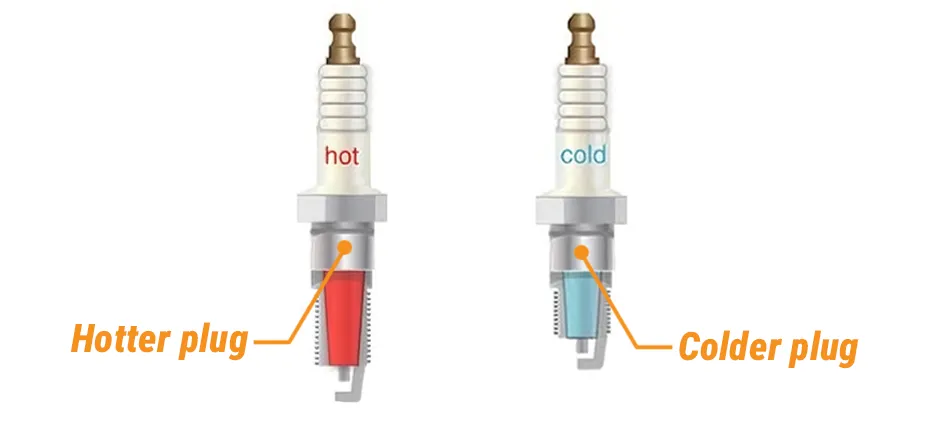
A too-hot heat range shows up as heat stress at the firing end. If you see these signs, stop treating it as “just a bad plug” and address heat range, mixture, timing, and cooling.
If you’re seeing signs of extreme heat, it’s also wise to investigate the cooling system itself. For instance, ask yourself, “Why is my coolant boiling?” as this could be a related or underlying issue.
Clear statement: “If the plug tip is becoming a hot spot, you’re flirting with pre-ignition.”
A too-cold heat range shows up as deposits and wet fouling. This is common on machines that idle a lot or never get a long, hot working cycle.
It’s important to distinguish fouling from other issues. For example, the presence of oil on spark plugs points toward mechanical problems like worn piston rings or valve seals, not just a cold heat range.
Quote: “A plug that never reaches self-cleaning temperature will keep loading up.”
You should change the heat range only after confirming the engine is mechanically healthy and correctly tuned. Heat range is a fine adjustment, not a band-aid for low compression, a leaking injector, wrong carb jetting, or incorrect timing.
You should consider a hotter plug when the duty cycle is mostly low-load, and fouling is consistent. Examples include long idling with hydraulics off, short moves around a yard, winter warm-ups, or low-speed property maintenance.
You should consider a colder plug when the duty cycle is sustained at a high load, and you see heat signs. Examples include long hill pulls, deep mud/sand operation, continuous PTO-type loading, or hot-weather high RPM work.
Clear statement: “Fix tune and fuel first; change heat range second.”
Heat range numbering is not universal. A “higher number” is hotter on some brands and colder on others.
Use the manufacturer’s chart for your exact plug family. If you’re comparing options, rely on an internal cross-reference instead of guessing from the number.
To keep it simple during purchasing and troubleshooting, use an internal reference like a spark plug heat range chart for the brand you run.
To use a heat range chart correctly, you must begin with the spark plug that matches your engine’s original specifications. Off-road engines are sensitive to the correct reach, seat type, and projected tip design. Using the wrong physical plug is a bigger problem than being one step off on heat range.
Quote: “One heat-range step is an experiment; two steps is a gamble.”
Plug reading should be done after a representative work cycle and a clean shutdown. If you only idle in the yard and pull the plug, you’ll “diagnose” a cold-fouling problem even if the machine runs fine under load.
Focus on repeatable patterns, not one plug from one cylinder. Compare cylinders if possible, because a single oily cylinder can mimic the wrong heat range.
Treat extreme findings as a warning to inspect fueling and timing. Heat range cannot correct a lean condition, overheating cooling system, or incorrect ignition advance.
Clear statement: “Heat range can fine-tune temperature; it cannot fix a bad tune.”
Small habits prevent most heat-range headaches.
Spark plug heat range controls plug tip temperature, and the right range prevents both fouling (too cold) and heat damage (too hot). If you’ve verified the engine is healthy and correctly tuned, choose only a one-step heat range change and confirm it under real working conditions. When you’re ready to replace or stock spares, visit MechLink’ product listings and choose a compatible spark plug that matches your engine’s specs and your workload.