2026-10-15
Heavy-duty lights improve visibility for operators, allowing them to dig, grade, and load with precision and safety. Moreover, shouted warnings and hand signals are easily missed on a loud job site. That’s when your equipment’s lighting system becomes its voice, signaling critical actions such as stopping, turning, or reversing. For this reason, we’ll talk about the key heavy-duty lighting, explaining the function of each lighting type and its importance. Make your workplace safer with our comprehensive guide to heavy-duty lights.
The primary forward-facing lights on any machine are responsible for illuminating the path ahead and the immediate work area. While they might look similar, their functions are distinct and crucial for both travel and operation.
These are the most important lights for productivity. Unlike standard headlights designed for travel, are engineered to bathe the immediate work area—the trench you’re digging, the pile you’re loading, or the ground you’re grading—in bright, clear light. Modern LED work lights offer superior brightness, durability, and a clean white light that reduces operator eye strain over long shifts. They are typically mounted on the cab, boom, and body of the machine to provide wide-area illumination.
For machines that travel across large job sites or down haul roads, traditional high and low beams are essential.
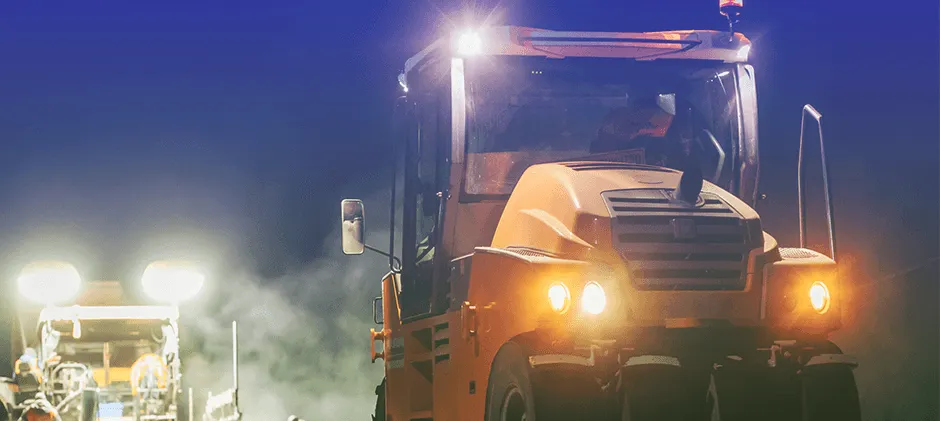
What happens behind the machine is just as important as what happens in front. Tail and brake lights are your primary tools for communicating your machine’s movements to others on the site.
The heavy-duty lights, the steady red lights on the rear, are tail lights. Their sole purpose is to make the machine visible from behind. In dusty conditions, at dusk, or during the night, these lights define the machine’s presence and width, helping other operators maintain a safe following distance and preventing rear-end collisions.
Brake lights are brighter than taillights and activate only when the operator applies the brakes. They provide a clear, unmistakable signal that the machine is slowing down or stopping. On a busy, noisy construction site where engine sounds can drown out other cues, this visual signal is a non-negotiable safety feature.
These lights communicate your intentions to other operators, turning a chaotic work environment into a more predictable and safer space. They are all about signaling movement and presence.
Just like on a car, turn signals (or indicators) are flashing amber lights on the front and rear of the machine. They signal the operator’s intention to turn left or right. Using them consistently is critical on sites with multiple pieces of equipment moving in different directions, as it prevents confusion and potential side-impact accidents.
Often called strobes or beacons, these are high-intensity flashing lights designed to grab attention. A warning light signals that a machine is in operation, reversing, or may pose a potential hazard to those nearby. They are typically amber and mounted on the roof of the cab for 360-degree visibility.
Pro Tip: A functioning beacon is often a requirement on job sites. It’s one of the most effective ways to alert ground personnel and other operators that a large machine is active, especially in their blind spots.
The dashboard lights inside the cab are the machine’s way of communicating with the operator. Ignoring them can lead to catastrophic equipment failure. They fall into two main categories.
Warning Lights
These are the most critical lights on your dashboard. They are typically red or amber and indicate a serious problem that could damage the machine or create an unsafe condition. Common examples include:
These lights, often green or blue, are informational. They don’t signal a problem but confirm that a specific system is engaged. This includes lights for the parking brake, differential lock, or Power Take-Off (PTO) system.
Beyond the standard set, many machines are equipped with or can be upgraded with specialty lights for specific tasks and enhanced performance.
While not a “type” of light by function, the shift to LED lighting is a technology that has revolutionized heavy equipment. Almost every light type mentioned above is now available in an LED version. Compared to old halogen bulbs, LEDs are:
For excavators, backhoes, and telehandlers, shadows cast by the boom can hide the most critical work area. Attachment lights are mounted directly on the boom or stick, near the bucket or forks. This ensures the point of contact with the ground is always perfectly illuminated, regardless of the boom’s position, for maximum precision and safety.
A light is only useful if it works. Regular maintenance is simple but vital.
Lighting technology has come a long way, but the demands of modern job sites keep growing. Your lights need to withstand constant vibration, shocks, and extreme weather to minimize downtime and maintenance costs. Still, figuring out how to choose heavy equipment LED work lights isn’t as easy as picking something off a shelf.
That’s where our 16 years of experience in the heavy-duty industry come in. MechLink makes it easier by offering practical solutions and 8 tips to choose the right lights for tractors and farm machinery. From durability to compatibility, we simplify the process by providing a wide selection of construction lights. Get in touch with us today—our heavy-duty lighting keeps your machines safe on the job.