2026-05-11
It’s annoying to halt your schedule due to the flashing warning lights, but more disruptive is that you don’t know what they mean. This guide will list the complete Caterpillar Fault Codes and explain what they mean. Actually, they are not random numbers but a precise language to help you diagnose problems quickly. Follow this guide carefully, and you can clear your confusion.
Caterpillar has evolved its diagnostic systems over the years. Because of this, you might encounter codes in a few different formats, or “dialects.” Knowing which type of code you’re looking at is the first step.
Here are the four most common formats you will see:
We will break down each of these, starting with the foundational format: MID, CID, and FMI.
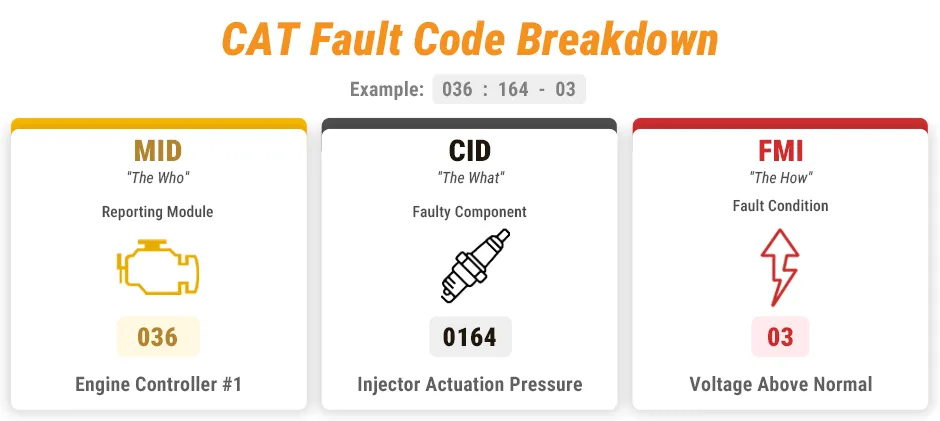
The most common diagnostic code is made of three parts. Think of it like a short sentence that answers three questions: Who is reporting the problem? What part is the problem? And how is it failing?
These three parts are:
Let’s break them down.
The MID tells you which Electronic Control Module (ECM) on the machine has detected and reported the fault. Modern machines have multiple ECMs, each managing a different system. Knowing the MID is the first step to narrowing down the location of the problem.
Common MID Codes:
| MID | Module Name | System It Controls |
| 036 | Engine Controller #1 | Engine performance, fuel, and emissions. |
| 027 | Transmission Controller | Gear shifting and drivetrain management. |
| 081 | Chassis Controller | Brakes, steering, and chassis functions. |
| 082 | Implement Controller | Hydraulic arms, bucket, blade, etc. |
| 113 | Monitoring System | The main display panel and warning system. |
| 039 | Machine Controller | Coordinates all other modules for overall machine function. |
| 145 | Product Link Module | Telematics and remote monitoring (VisionLink). |
The CID is the heart of the fault code. It pinpoints the exact component that the ECM believes is faulty. This could be a sensor, a solenoid, an injector, or a specific circuit. The CID is what tells you which part you need to inspect, test, and potentially replace.
The FMI is arguably the most important part for diagnostics. It describes the specific type of failure the component is experiencing. For example, is a sensor’s signal voltage too high, or is its current too low? The FMI tells you exactly what to look for when testing the component and its wiring.
Official FMI Code List:
| FMI | Failure Description | Common Causes |
| 00 | Data Above Normal Range | Pressure, temperature, or level is too high. |
| 01 | Data Below Normal Range | Pressure, temperature, or level is too low. |
| 02 | Erratic or Incorrect Data | Loose wiring, bad connection, failing component. |
| 03 | Voltage Above Normal | The signal wire is shorted to a power source. |
| 04 | Voltage Below Normal | The signal wire is shorted to ground. |
| 05 | Current Below Normal / Open Circuit | Broken wire, unplugged connector, burnt-out solenoid. |
| 06 | Current Above Normal / Grounded Circuit | The wire insulation rubbed off and touched the frame. |
| 07 | Mechanical System Not Responding | Stuck valve, hydraulic or pneumatic failure. |
| 08 | Abnormal Signal (Frequency, Pulse) | Damaged speed sensor, signal interference. |
| 09 | Abnormal Update Rate | Communication error on the data bus. |
| 10 | Abnormal Rate of Change | The parameter is changing too fast or too slow. |
| 11 | Failure Mode Not Identifiable | An unknown error was detected by the ECM. |
| 12 | Bad Device or Component | ECM has self-tested the component and found it faulty. |
| 13 | Out of Calibration | The component requires a calibration procedure. |
| 14 | Special Instruction | A specific, non-standard procedure is required. |
| 19 | Received Network Data Error | Data from another module is corrupt. |
If your code doesn’t look like MID: CID-FMI, it’s likely one of these other formats.
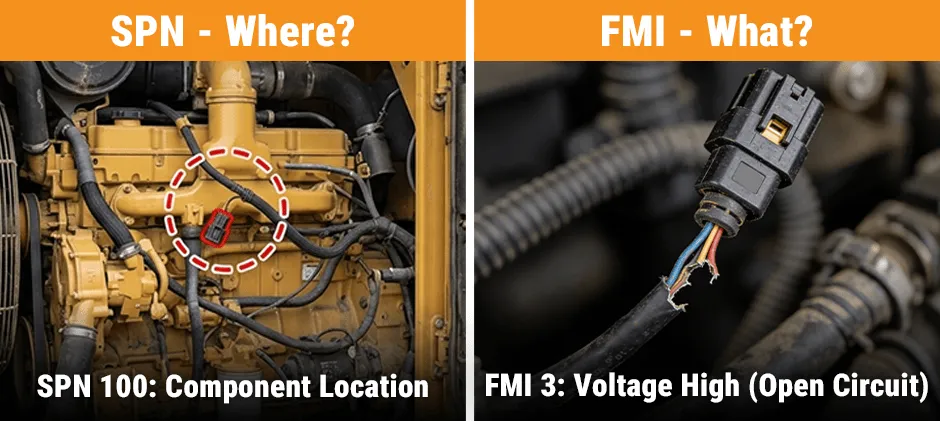
Newer machines often use the SAE J1939 communication standard. These machines use an SPN (Suspect Parameter Number) instead of a CID. The SPN still identifies the faulty component or system, but the numbers are standardized across different manufacturers.
IMPORTANT: The FMI number list for J1939 can sometimes differ from the classic CAT FMI list. Always refer to a J1939-specific FMI chart when diagnosing these codes.
Sometimes, the machine will log an Event Code instead of a diagnostic code. An Event Code, identified by an “E” and an Event Identifier (EID), tells you that an undesirable machine condition has occurred, not necessarily that a component has failed.
For example, an event code might tell you Engine Coolant Temperature is High, whereas a diagnostic code would tell you Engine Coolant Temperature Sensor Voltage is Low.
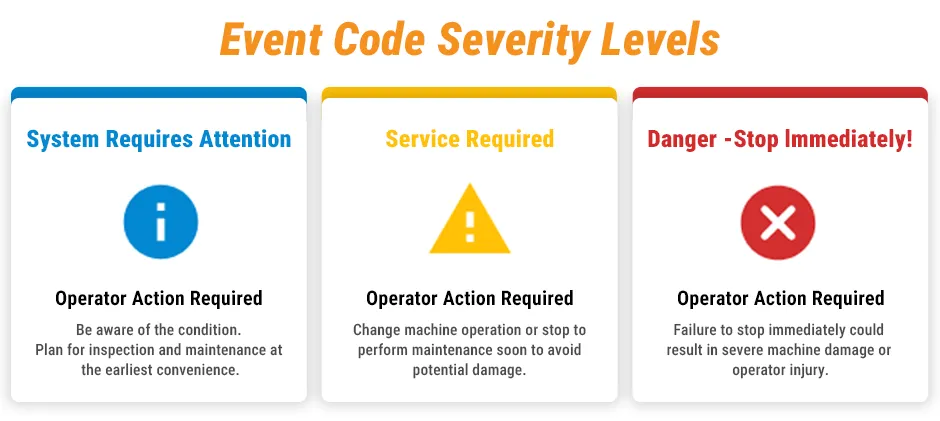
These codes are often paired with a Severity Level from 1 to 3.
| Severity Level | Indicator Light | Meaning | Operator Action Required |
| 1 | White / Blue | System Requires Attention. The condition is not dangerous, but should be checked at the earliest convenience. | Be aware and plan for maintenance. |
| 2 | Yellow / Amber | Service Required. The machine’s operation must be changed, or maintenance is required soon to avoid damage. | Change the machine operation or stop to perform maintenance. |
| 3 | Red | Danger – Stop Immediately! Severe condition detected. Failure to stop immediately could result in machine damage or operator injury. | Safely stop the machine immediately. |
Let’s see how this works with some examples from your provided text.
Code: 36: 164 – 3
Breakdown:
Conclusion: The Engine Controller has detected that the voltage from the Injector Actuation Pressure sensor is too high. The problem is likely a short circuit in the wiring or a failed sensor.
Code: 639:9
Breakdown:
Conclusion: This is a communication error. The ECM is not receiving data from another module on the J1939 network correctly. This often points to a wiring issue in the data link harness or a problem with another module on the network.
Code: E695-3
Breakdown:
Conclusion: The machine has detected dangerously high fuel pressure in the aftertreatment (emissions) system. The (3) indicates the operator must stop the machine safely and immediately to prevent damage.
You can retrieve these codes in two main ways:
To help you get started, here is a list of some of the most common CIDs you might encounter.
Common Engine System CIDs:
| CID | Component Name |
| 0091 | Throttle Position Sensor |
| 0094 | Fuel Delivery Pressure Sensor |
| 0100 | Engine Oil Pressure Sensor |
| 0110 | Engine Coolant Temperature Sensor |
| 0168 | Electrical System Voltage |
| 0172 | Intake Manifold Air Temperature Sensor |
| 0190 | Engine Speed Sensor |
| 0262 | 5 Volt Sensor DC Power Supply |
| 0268 | Programmed Parameter Fault |
| 0651 – 0656 | Cylinder #1 – #6 Injector |
You can identify the system, the component, and the nature of the failure with the help of these codes.
But what’s the next step? Now that you’ve diagnosed the problem, how do you fix it? In our next post, 5 Minutes to Fix: Caterpillar Fault Codes Troubleshooting Guide, we will guide you on how to turn your diagnosis into a solution and get the right parts to get your machine back to work, fast.
Then visit MechLink to find the quality CAT replacement parts for your equipment!