2026-05-08
From skid steer loaders to hydraulic excavators, the core components of every internal combustion engine may be considered as constituted by two parts: the camshaft and the crankshaft. Comprehending the distinction between these two shafts is not merely confined to the grasp of mechanical theory—it also facilitates the prevention of costly malfunctions, enhances the efficiency of torque, and ensures that your equipment can operate smoothly irrespective of terrain conditions or loading circumstances. In this guide, we shall elaborate in detail on the functions of the camshaft and crankshaft, identify signals serving as precursors to failure, explore the underlying causes of such malfunctions, and provide explanations on the procedures for replacing these components so as to maintain the continuous, smooth operation of your off-highway machinery.
The camshaft controls how your off-road engine breathes—opening and closing valves for air and fuel flow—while the crankshaft converts piston motion into the torque that drives your machinery. Both must work in perfect sync, and when one fails, the whole system suffers.
Before comparing them, let’s understand how they operate individually—and how they work together.
| Component | Main Function | Location in Engine |
| Camshaft | Opens & closes intake/exhaust valves | Cylinder head or block |
| Crankshaft | Converts piston motion to torque | Lower engine block |
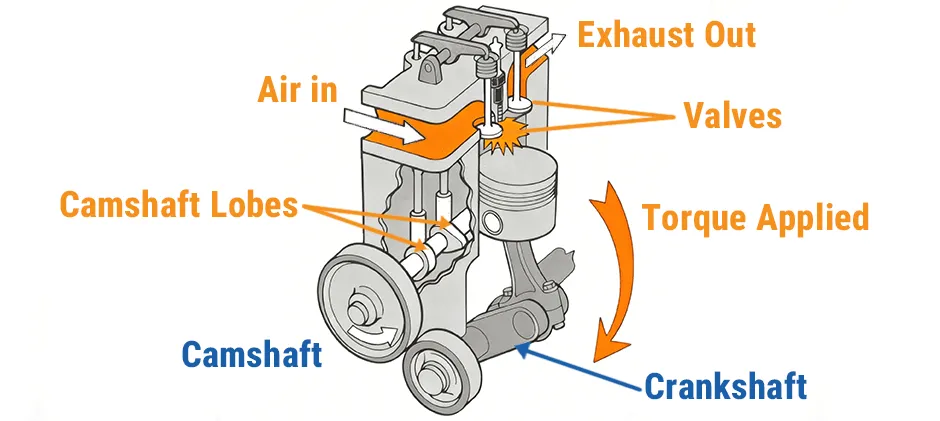
The camshaft is the precision-timing device of the engine. Its cam lobes push against valve lifters or rocker arms to open and close valves at the exact moments fuel and air need to enter—or exhaust gases need to exit.
There are typically two camshaft layouts in heavy equipment:
Because the camshaft’s movement is linked directly to the crankshaft through a timing chain, gear set, or belt, it rotates once for every two crankshaft revolutions. This relationship keeps combustion timing perfectly synchronized.
The crankshaft transforms reciprocating piston movement into rotational torque. Every piston stroke pushes a crank throw, converting explosive combustion into turning motion that powers the driveline, hydraulics, or output shafts in heavy machinery.
Typical crankshaft components include:
In heavy-duty engines, crankshafts are often forged from high-grade alloy steel for strength under constant pressure. If damaged, the torque output and engine stability drop drastically.
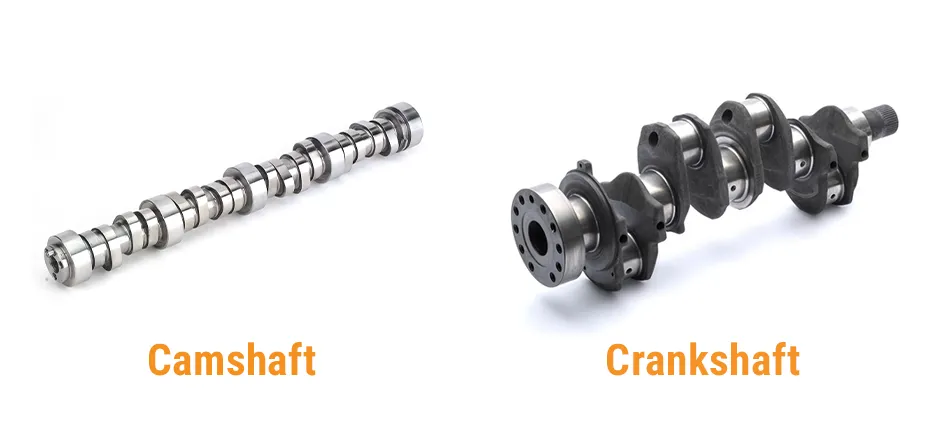
At the most basic level, the crankshaft converts the up-and-down motion of pistons into a rotational force (torque). That torque then travels through the drivetrain or hydraulic system, powering your bulldozer tracks, loader arms, or excavator hydraulics.
In contrast, the camshaft is the timing brain of your combustion system. Its rotating lobes push on valve lifters or rockers to open and close intake and exhaust valves with perfect synchronization. Without the camshaft’s rhythm, the crankshaft’s power goes to waste.
Inside most off-road diesel engines:
| Shaft | Location | Material | Key Components |
| Crankshaft | Deep inside the engine block (bottom end) | Forged or billet steel for extreme durability | Main journals, rod journals, counterweights, crankshaft pulley |
| Camshaft | Either in the block (pushrod design) or above it (overhead design) | Hardened steel or cast iron | Cam lobes, bearings, gear or chain drive, valve actuators |
The weight of the crankshaft is increased to a remarkable extent, as it must withstand explosive combustion pressures that may reach several thousand pounds per square inch (PSI) for each cylinder. Although the camshaft possesses a more slender structure, it is still required to maintain precision at the microsecond level, so as to guarantee that every valve-timing action remains accurate without deviation.
In contrast to light automotive engines, engines used in off-road vehicles generally adopt a gear-driven camshaft instead of a belt-driven one. Gears are capable of achieving a longer service life under conditions of vibration and temperature fluctuation, and they are also able to eliminate the possibility of slippage — a characteristic that is of essential importance for large diesel engines such as those employed in excavators and bulldozers.
During one full combustion cycle (four strokes):
This 2:1 ratio ensures the valves open and close at the right moments relative to piston position.
If this relationship slips because of a worn timing gear or damaged tooth, the pistons and valves can collide—destroying both shafts instantly. That’s why periodic inspection of the timing components (chain, gear, or belt) is vital for maintenance planners in off-highway fleets.
Each system dictates the service life of both shafts and affects engine noise, efficiency, and ease of timing adjustments.
While both are built to endure heavy stress, their wear patterns differ—crankshaft journals typically experience oil film failure, while camshafts suffer from uneven valve lash or spring pressure wear.
Neither the camshaft nor the crankshaft can function alone. The crankshaft provides the driving force, spinning via combustion power; the camshaft receives that motion through a timing transfer system.
If the crankshaft falters, the engine loses torque completely; if the camshaft fails, timing goes haywire, resulting in valve-piston contact or backfiring. Both must remain synchronized for complete engine “breathing.”
Here’s the dynamic in simple terms:
| Engine Stroke | Crankshaft Role | Camshaft Role |
| Intake | Pulls the piston down to draw in air and fuel | Opens intake valves |
| Compression | Drives the piston upward | Keeps both valves closed |
| Power | Rotates under combustion force | Holds both valves shut |
| Exhaust | Pushes exhaust gases out | Opens exhaust valves |
Proper valve timing equals correct air-fuel exchange, which equals maximum torque and fuel efficiency—two things off-road fleet owners cannot sacrifice.
If any one of these components experiences a failure, the consequences may be considered extremely serious:
For the purpose of ensuring mechanical reliability, it is essential to make use of high-quality replacement crankshafts or camshafts that have undergone off-road testing. Inferior or roughly processed parts may produce imbalance or journal taper, thereby causing premature wear to the entire lower section.
Recognizing early warning signs helps you save on expensive overhauls.
Often, technicians confuse camshaft wear with sensor malfunction, which is why both camshaft position sensors and crankshaft position sensors must be tested before assuming mechanical failure.
Even premium off-road engines face extreme working conditions—heat, vibration, moisture, and heavy load cycles—all of which contribute to wear.
To replace worn lobes or camshafts, it’s critical to use high-quality camshafts or camshaft components tested for heavy-duty applications.
When replacement is unavoidable, choose a crankshaft crafted from forged steel for durability under high compression. Don’t forget that the crankshaft pulley also plays a balancing role; a worn pulley accelerates crankshaft wear.
In an off-road machine’s engine, the camshaft and crankshaft are connected through:
Each mechanism must stay aligned. When valve timing drifts, cylinder compression drops, and the engine loses torque and efficiency. Always inspect tensioners, belts, or gears during every major service.
Both are essential—the crankshaft drives motion, the camshaft manages timing. Without synchronization, the engine fails.
Yes, minor scoring can be ground and polished, but severe cracks require a new crankshaft.
It controls valve operation—ensuring torque and combustion efficiency are optimized for heavy terrain.
Watch for misfires, a drop in fuel efficiency, and the engine stalling intermittently.
If you notice performance deterioration after 5,000+ operation hours or visible wear during engine rebuild inspections, replacement is advisable.
In any type of off-road machinery, the camshaft and the crankshaft may be regarded as existing in rhythm and power—neither can be absent. Only an engine that is balanced and possesses accurate timing is able to operate in a safe condition while delivering strong torque at the moment when it is most required. MechLink provides aftermarket components of high quality, with pricing that remains affordable, durability that is sufficiently strong, and compatibility with a wide range of mainstream heavy-equipment models, thereby ensuring that your operations are able to continue in an efficient state. You may browse through our product catalog immediately so that your machinery may retain powerful output and maintain smooth operation.