2026-10-11
For off-road machinery owners, a good functioning AC compressor is very important. Without it, the operator’s productivity can be reduced and lead to more issues, even costly downtime. So, what can you do when an AC compressor is failing? How much does it cost?
A repair often ranges from $200 – $600, while a full replacement of a heavy-duty AC compressor in 2026 will cost between $500 and $2,500. This guide will tell you what makes up the cost, factors that influence the cost, and why the range is so wide.
A repair is only possible if the compressor’s internal pump mechanism is still healthy. The problem must be limited to an external, bolt-on component. If you’re lucky, your issue might be one of these, saving you significant time and money and minimizing immediate downtime:
More often than not, a compressor failure is catastrophic and internal. In these cases, a repair is not an option, and attempting one is a waste of money. A replacement is non-negotiable if you see these signs.
The 50% Rule: A good financial guideline is to compare costs. If the estimated price of a repair is more than half the cost of a brand-new compressor, a full replacement is the smarter long-term investment for durability and preventing future downtime.
The total cost is a sum of two main categories: the price of the parts themselves and the cost of the specialized labor required for a reliable installation.
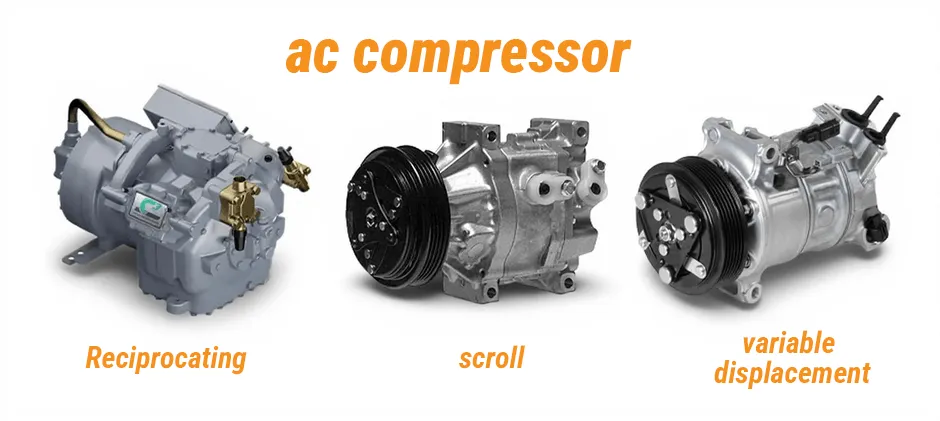
The part cost varies depending on the different AC compressor types:
Reciprocating (Piston) Compressors: The archetypal workhorse, its fortified architecture ensures resilience against intense vibration, prioritizing ultimate durability. It remains a judicious, budget-conscious choice for legacy equipment.
Scroll Compressors: The prevailing modern criterion, hallmarked by a paucity of motile constituent elements. Such configuration begets preeminent efficacy and sonorous diminution, thereby ameliorating practitioner ergonomics whilst guaranteeing elevated functional verisimilitude amidst negligible cessation intervals.
Variable Displacement Compressors: The apex of compressor technology, these units eschew binary cycling to dynamically modulate output, precisely matching thermal demand. This minimizes parasitic engine load and optimizes fuel economy, representing the optimal long-term investment for high-use machinery where mitigating operational costs is critical.
| Compressor Type | Unit Cost | Best For |
| Reciprocating | $150 – $400 | Maximum durability in harsh conditions, older machines, and budget-focused repairs. |
| Scroll | $300 – $700 | The modern standard for balancing fuel efficiency, operator comfort, and reliability. |
| Variable Displacement | $600 – $1,200+ | Minimizing long-term operating costs and maximizing productivity in high-use machinery. |
Expect to pay a specialized heavy equipment technician between $90 and $180 per hour. The final labor time is heavily influenced by two factors:
Beyond the main part and standard labor, several other elements will appear on your final invoice.
If contamination has occurred, the only correct repair is to install a compressor kit. These kits include a new compressor, receiver/drier, expansion valve, and sometimes a condenser. While this increases the upfront parts cost, it is the only way to guarantee the longevity of the repair and prevent a repeat failure.
The system must be evacuated and recharged with new refrigerant (commonly R-134a or the newer, more expensive R-1234yf) and the correct type of compressor oil. This can add $100 – $250 to the cost.
A technician will charge a fee (often $100-$200) to perform a thorough diagnosis. This is a wise investment to ensure the compressor is the actual root cause before spending money on the wrong parts.
This particular financial expenditure is not explicitly delineated on the transactional receipt; nonetheless, it constitutes the most substantial financial detriment to the commercial enterprise. Each temporal unit wherein the machinery remains in a non-operational state directly correlates with a quantifiable forfeiture of revenue-generating potential. Consequently, the allocation of capital towards a high-standard restorative procedure effected through the utilization of components of established reliability is tantamount to a direct investment oriented towards the maximization of the equipment’s operational availability.
Ultimately, replacing a heavy-duty AC compressor is a decision about protecting your assets and productivity. By understanding how each choice impacts durability, operating costs, and potential downtime, you can make an informed decision that benefits your operation long after the repair bill is paid.
Whether your AC compressor needs repair or replacement, the money you spend is for minimizing downtime and protecting your long-term operating investment. As a result, choosing a reliable part for your AC compressor is critical.
MechLink is here to help. We specialize in offering high-quality AC compressors for heavy-duty machinery, compatible with major brands, including John Deere, Toyota, Ingersoll-Rand, and more. Choosing MechLink, gain high-quality parts at a low price. Fix it once, fix it right.
Ready to get your machine’s AC running again? Visit MechLink to find the exact compressor for your model and get back to work.
Here are more replacement cost guides for the fuel filter, thermostat, blower motor, air filter, fuel pump, fuel injector, EGR cooler, and water pump.