
2026-05-25
It’s not easy to find the right Kubota excavator for your project, as many factors need to be taken into consideration, including operating weight, digging depth, and tail swing. Getting the performance you need without overpaying starts with understanding Kubota’s two distinct excavator series: the U Series and the K Series. This guide offers detailed dimensional information for each model in each series, and we hope it helps you select an excavator for your project, ranging from landscaping and utility work to general construction.
Kubota focuses on producing powerful and reliable small excavators. Its entire product line falls into the “mini” or “compact” class, with weights typically ranging from one ton to over eight tons. The models are divided into two different series according to the tail swing design: the U series and the K/KX series.
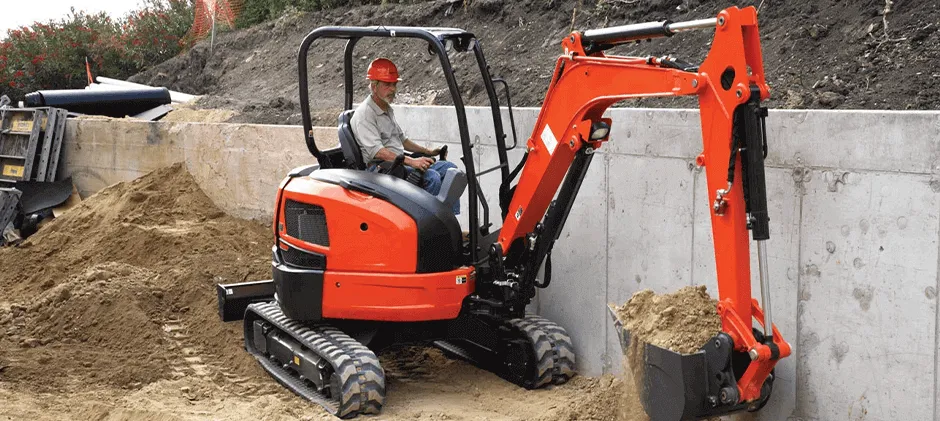
The Kubota U Series is engineered for one primary purpose: to work perfectly in confined areas. These models feature a zero or tight tail swing design. Keeping the entire machine within its track footprint, you can rotate the U Series freely without worrying about hitting walls, fences, or other obstacles, which is ideal for urban construction, residential landscaping, and utility trenching near busy roads.
When your job site is measured in inches, not acres, a zero-tail-swing excavator is a necessity. If your work involves demolition inside a building, digging foundations next to existing structures, or landscaping in established backyards, the U Series is your go-to choice.
| Model | Overall Length | Width | Height | Net Power | Max Digging Radius | Operating Weight | Max Digging Depth | Max Dump Height |
| U10-5 | 9 ft. 9 in. | 2 ft. 6 in. – 3 ft. 3 in. | 7 ft. 5 in. | 10.3 HP | 10 ft. 6 in. | 2,646 lbs | 5 ft. 11 in. | 7 ft. 3 in. |
| U17 | 11 ft. 7 in. | 3 ft. 3 in. – 4 ft. 1 in. | 7 ft. 8 in. | 16.1 HP | 12 ft. 9 in. | 3,891 lbs | 7 ft. 7 in. | 8 ft. 0 in. |
| U25 | 1 3 ft. 7 in. | 4 ft. 11 in. | 7 ft. 11 in. | 20.9 HP | 15 ft. 5 in. | 5,625 lbs | 9 ft. 3 in. | 10 ft. 6 in. |
| U27-4 | 1 3 ft. 6 in. | 4 ft. 11 in. | 7 ft. 11 in. | 20.9 HP | 15 ft. 5 in. | 6,107 lbs | 9 ft. 5 in. | 10 ft. 0 in. |
| U35-4 | 15 ft. 7 in. | 5 ft. 7 in. | 8 ft. 1 in. | 24.8 HP | 17 ft. 2 in. | 8,488 lbs | 9 ft. 9 in. | 11 ft. 1 in. |
| U48-5 | 17 ft. 7 in. | 6 ft. 5 in. | 8 ft. 4 in. | 40.0 HP | 18 ft. 4 in. | 10,848 lbs | 10 ft. 8 in. | 12 ft. 9 in. |
| U55-5 | 17 ft. 10 in. | 6 ft. 5 in. | 8 ft. 4 in. | 47.6 HP | 19 ft. 6 in. | 12,247 lbs | 11 ft. 11 in. | 1 3 ft. 1 in. |
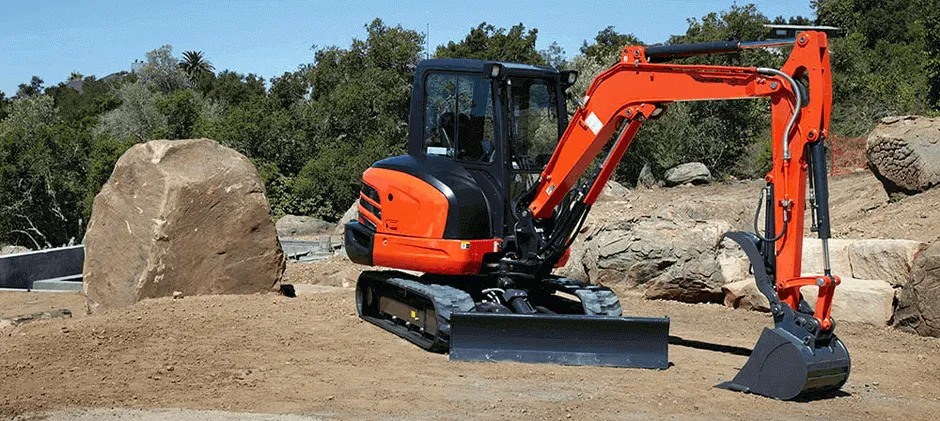
Where the U Series prioritizes agility in tight spaces, the Kubota k/KX Series prioritizes raw power and stability. These models use a conventional tail swing design, where the rear counterweight extends beyond the tracks during rotation. The extended counterweight provides a more stable platform, allowing for greater lifting capacity and more aggressive digging.
The k/KX Series excels in environments with ample room to operate, such as general construction sites, agricultural projects like ditching and land clearing. This series includes Kubota’s smallest excavator, the K008-5, as well as its largest compact excavator, the KX080-5.
| Model | Overall Length | Width | Height | Net Power | Max Digging Radius | Operating Weight | Max Digging Depth | Max Dump Height |
| K008-5 | 9 ft. 0 in. | 2 ft. 4 in. – 2 ft. 10 in. | 7 ft. 4 in. | 10.3 HP | 9 ft. 11 in. | 2,200 lbs | 5 ft. 8 in. | 6 ft. 8 in. |
| KX018-4 | 12 ft. 2 in. | 3 ft.3 in. – 4 ft.3 in. | 7 ft. 8 in. | 16.1 HP | 12 ft. 10 in. | 3,847 lbs | 7 ft. 10 in. | 7 ft. 10 in. |
| KX030-4 | 15 ft. 1 in. | 4 ft. 11 in. | 7 ft. 11 in. | 23.2 HP | 16 ft. 1 in. | 6,272 lbs | 9 ft. 7 in. | 10 ft. 4 in. |
| KX033-4 | 15 ft. 6 in. | 5 ft. 1 in. | 8 ft. 1 in. | 24.8 HP | 17 ft. 3 in. | 7,420 lbs | 10 ft. 6 in. | 11 ft. 7 in. |
| KX040-4 | 16 ft. 8 in. | 5 ft. 7 in. | 8 ft. 2 in. | 40.4 HP | 18 ft. 4 in. | 9,195 lbs | 11 ft.3 in. | 12 ft. 10 in. |
| KX057-5 | 18 ft. 1 in. | 6 ft. 5 in. | 8 ft. 4 in. | 47.6 HP | 20 ft. 0 in. | 12,346 lbs | 12 ft. 9 in. | 1 3 ft. 8 in. |
| KX080-4 | 21 ft. 2 in. | 7 ft.3 in. | 8 ft. 4 in. | 66.4 HP | 24 ft. 4 in. | 18,596 lbs | 15 ft. 1 in. | 17 ft.3 in. |
| KX080-5 | 21 ft. 2 in. | 7 ft.3 in. | 8 ft. 4 in. | 66.6 HP | 24 ft. 4 in. | 18,783 lbs | 15 ft. 1 in. | 17 ft.3 in. |
Now that we’ve seen the specifications, how do you translate them into the right choice for your job? Simply picking the biggest machine you can afford is rarely the best strategy. Ask yourself these four questions:
Picking the right size Kubota excavator is all about knowing your job site. The flexible U Series, for example, is an ideal choice for confined spaces, while the robust KX Series delivers maximum stability and power for open job sites. By using the tables and considerations above, you can find the exact model for your needs.
Once you have your Kubota excavator, the next step is keeping it running smoothly. As a trusted aftermarket parts supplier, MechLink stocks a large selection of reliable parts at great prices. Our parts fit Kubota machinery perfectly, so you can get exactly what you need to keep your machine ready for work, helping save time and reduce downtime!
Kubota KX040-4 is cited as the most popular conventional tail swing excavator, not just for Kubota but in the entire 4-ton class. It’s powerful enough for significant work like digging stumps and grading, yet light enough to be legally towed by a one-ton truck.
The numbers in the model name provide a quick reference to the machine’s approximate operating weight in metric tons. The number is typically the metric tonnage multiplied by 10. For example:
A U35 is in the 3.5-metric-ton class (approx. 8,000 lbs).
A KX040 is in the 4.0-metric-ton class (approx. 9,000 lbs).
This is an industry convention to help you quickly gauge size, but always refer to the specification chart for the precise operating weight.
Generally, for a similar weight and horsepower class, a U Series (zero/tight tail swing) excavator is more expensive than a K/KX Series (conventional tail swing) model. The higher price is due to the more complex engineering required to create the compact zero-tail-swing mechanism.
Yes, but compatibility is determined by machine size, not the series name. As long as the attachment is properly sized for the machine’s weight class and power output, it can often be used on either a U or KX model. For example, an attachment for a KX040-4 would likely be suitable for a U48-5, as they are in a similar class. Always verify compatibility based on the machine’s and attachment’s specifications.
What are the types of engine belts?
2026-09-14
Bobcat excavator sizes select guide: choose the best size
2026-09-14

How much does a diesel fuel filter replacement cost?
2026-09-13
Is a dpf delete worth it? the real risks for your machinery
2026-09-13