
2026-11-26
A boom lift belongs to the aerial lift family: it carries an operator upward and outward so work can be done in places that ladders and scaffolding cannot easily reach.
Construction and agriculture crews rely on them for painting, ceiling repairs and picking fruit from tall trees. The link to orchards runs deep enough that the machines still carry the nickname “cherrypickers” — the earliest boom lifts were built to reach cherries.
Whatever the job, the machine will fall into one of two broad groups: telescopic or articulating. Both hang a platform or basket from a boom arm. What separates them is the way that arm is built.
On a telescopic boom lift, the arm extends along a single straight line. Most of these machines sit on a rotating base, so the operator can aim the whole unit into position first and only then push the arm out.
Because the arm is rigid, telescopic units are known for stability and long reach. They can place the basket far out horizontally without losing their footing.
Sizes range widely, with the most familiar models built to 40, 60, 80, 120, 150 and 180 feet. Power comes from either a battery pack or a diesel engine, and electric versions are the usual pick for indoor work.
An articulating boom replaces the single sliding arm with one that hinges. Those joints let the arm take on practically unlimited positions, which is how these machines get into awkward corners on cramped sites. Since the arm folds at several points, operators often call them knuckle lifts.
They suit tight sites where maneuverability decides the schedule. An articulating unit can reach up and then over an obstruction, which is why HVAC repair, fire sprinkler installation and ceiling maintenance are natural jobs for it.
One record-breaking model reaches 210 feet, but the majority of articulating arms are built far shorter: 30, 45, 60, 80, 120 and 150 feet are the standard offerings.
The dividing line is simple. One arm only extends; the other bends.
Telescopic sections slide in and out the way the pieces of a fishing rod do, and they cannot pivot at all. An articulating arm hinges at multiple points, so it can be folded into a much wider range of shapes.
Rigidity buys stability. Telescopic machines resist tipping while reaching far horizontally and usually carry more weight in the basket.
Articulating machines trade some of that stability for agility. They excel indoors and inside cluttered plants — repairing sprinkler lines above machinery in a factory or warehouse, for instance.
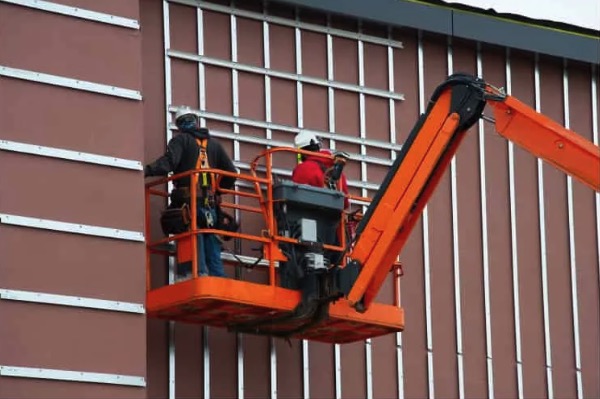
What sets a boom lift apart is the combination of height, horizontal offset, flexibility and precision.
A scissor lift travels only up and down, while a boom lift moves in both directions. The boom lift basket is also smaller, which is an advantage when the gap is narrow.
They are poor load carriers, though. The platform is small and the machine does not move around a site easily, so forklifts or telehandlers handle transport work with better stability.
Every boom lift ships with a platform or man basket, but attachments adapt it to particular tasks.
With so much choice on the market, a single machine can be reconfigured for very different work.
Electric, diesel and hybrid are the three common options, and each one is strong in a different setting.
Electric units run quietly and produce no emissions, which makes them the default for most indoor applications. They are also simpler to maintain than fuel-powered machines, but they must be plugged in to charge, so a site without power is a problem.
Diesel units are powerful and rugged, suited to outdoor work on difficult ground. High torque and fast ascent make them stronger than electric models, at the cost of noise, emissions and more involved maintenance.
Hybrid units blend the two: longer range than electric and better fuel economy than diesel. They are, however, the hardest to maintain and frequently cost more than either alternative.
Falls remain one of the leading causes of death on construction sites. A boom lift is safe when it is used correctly, yet working at height always demands preparation.
Begin every shift with the basket. Check that no railing is loose or missing and that every safety device is functioning.
Survey the ground and the airspace before climbing in. Uneven terrain, wind and overhead hazards such as electrical wires are especially dangerous for boom lifts, and the machine should stay parked until those conditions are resolved.
Finally, read the machine’s operating manual. For any specific model, it is the most reliable source of safety information.
MechLink Shop supplies OEM and aftermarket parts for boom lifts, including JLG, Genie and Skyjack machines. If a component is not listed, contact our parts team to arrange a custom order.

Forklift or telehandler? How to match the lift to the ground it works on
2026-11-26
Machine tracks: matching material and tread to the work you do
2026-11-26
Engine belts: four types, the symptoms of failure, and what a snapped belt really costs
2026-11-25
Telehandler attachments explained: six tools that change what the machine can do
2026-11-25